I have been thinking about how game companies design games with too much focus on particular things, often losing out in other important ways. Some examples:
In Skyrim, there are talent choices you can take that allow you to get critical hits. Crits do fixed amounts of damage in the neighborhood of 10. This is fine but not great when you get your first sword that does 25 damage in a swing, but becomes ridiculous when you fully upgrade and attack for 1000+ damage, with a chance to crit for 10 additional damage.
In Diablo 3 there is a talent called Gargantuan that summons a dork that blocks enemies and attacks them. It does about as much damage as your character can do spamming your best spells nonstop. In the endgame this ends up being okay because the extremely high powered sets make it possible to have builds with or without Gargantuan, but when levelling up it is ridiculous. How does it make any sense for me to be a caster when I can summon a random dude who does more damage by himself than my casting?
In DnD 5th edition there are a bunch of save or suck spells. One of them is Levitate, and it is a lot more powerful than the others because the enemy only gets a single save against it. However, when you are in a dungeon with a low ceiling Levitate often does nothing. But when you are outside, Levitate is regularly a save or die spell. You lift the enemy up, kill their friends, then leisurely shoot them with fire until they die. Balanced in a tiny hallway, ridiculous out of doors.
In Mass Effect 3, biotic explosions were based on the health of the enemy. They worked fine on lower difficulties, but on higher difficulties they were insane against the really high health enemies. They made other abilities with fixed damage ranges seem terrible.
There is no denying that it is hard to look at all of the possible situations a given ability can be used in and make them all balanced. Heck, perfect balance isn't even the goal as far as I am concerned - choosing Levitate when you are going to be fighting outdoors is an interesting tactical choice... we like those! The problem is when an ability is so out of whack in some situations that the gameplay becomes absurd if you don't make the 'correct' choice. Talents that have no measureable effect are not well designed. It is fine if they are niche, or largely there for flavour, but if all a talent is doing is pumping out numbers then it really needs to have numbers that work.
For example, there is a weapon in Diablo 3 that occasionally summons a bunch of cows with halberds to murder your enemies. The weapon is not good. It finds its way into zero endgame builds. However, that is fine because that weapon is fulfilling its role as giving people a few giggles when they equip it just to see what the heck it does. Nothing wrong with having some of those, in fact I quite like it when I game has that.
Similarly, there are talents like Angry Chicken that aren't good. But they don't have to be, because they turn you into a chicken, you run super fast, and then you blow people up. Badly. Which is okay, because you aren't using Angry Chicken to be good, you are using it to be a chicken. But when a talent like Gargantuan is so overpowered that you feel like an idiot for not using it, that is a problem.
When creating a mechanic all game designers should consider all of the ways in which it will be used. It is fine for a mechanic to be better in some circumstances, but it should do *something* in any circumstance where the player has reason to believe it will be effective. Games feel best, and have the biggest following, when there are choices to be made about numbers but those choices generally should jibe with the feel and the lore that the game has. When I am a summoner/nuker class, a single summon should not be more powerful than all my nukes combined. When a talent says that it makes a thing do more damage, that thing should do more damage in a noticeable way.
This sort of thing doesn't generally impact the super hardcore players very much as they will research the optimal builds and choices and go with them no matter how silly they seem. However, it has a huge effect on whether or not the average player enjoys the game and feels good about their choices in the game, and that is something that too often goes overlooked.
Showing posts with label Mass Effect. Show all posts
Showing posts with label Mass Effect. Show all posts
Thursday, January 21, 2016

Wednesday, November 13, 2013
Challenges
Video games really have it easy in a lot of ways when compared to pen and paper gaming. One of the biggest things they have going for them is the ability to put absurd challenges in front of players. I am playing Mass Effect 1 through on Insanity difficulty lately and it has made me laugh a few times when I think of doing the same scenarios in a tabletop RPG. In particular I found it amusing when my character hopped into a two meter pit and was informed by a squadmate that this was a one way trip because there was no way back up to the surface. Obviously the only solution was to go through the whole maze and disable the force field with random narratively powered properties; just climbing back out of the pit was out of the question. How could a squad of cybernetically enhanced future soldiers wearing power armour get up a two meter wall after all?The same thing happens all over. A rock blocks your path! I guess the only solution is to clear out an entire dungeon full of monsters to get a ladder, or a magic glove, or some other McGuffin to deal with the rock.
In a TTRPG of course the players will say things like "I climb back up the wall I guess, that sounds like the easiest solution" and then you have to figure something better out. Of course weak GMs tend to do things like randomly have magic everywhere so real world solutions aren't feasible. Every dungeon is a ludicrous maze of traps and magical junk that makes no sense - teleportation pads, elevator rooms, statues that spew acid and dispense treasure for no reason and other such kludges are the bread and butter of teenage gaming. If you try to do things in some vaguely reasonable way though making appropriate challenges becomes a ton harder. In a computer game the two meter wall is literally unbeatable (Sorry, we didn't add a jump button, I guess you have to follow the rails) but challenges have to be robust when the characters have lots of choices and you don't feel like shouting "It's fucking magic, stop trying to think".
I think I make things pretty hard for myself when I design TTRPG adventures. When I build a dungeon I carefully think out what every inhabitant is going to eat and drink, how they feel about each other, and why they haven't gone someplace else. If a weird magical thing is going on there needs to be a good reason for it because "Wizards are crazy and fill the world with stupid magical crap for no reason" sounds incredibly weak the fortieth time you say it. That sort of design does lend itself to the players accepting the dungeon as real but it makes it hard to put up straightforward challenges because they have so many options stemming from equipment, magic, and skills. Sometimes I really want to just deny them any options and teleport them into the middle of a gigantic magical maze where nothing works. It would sure take the stress level down a notch.
Thursday, October 24, 2013
Realism isn't so real
Recently I have been playing Mass Effect 1 again. It is distinctly different from the later entries in the series in a bunch of ways but I think the most important way is that it tries to present a real world you can interact with in all kinds of ways. ME2 and ME3 instead present rigid combat challenges you must overcome in a specific sequence with very restricted tactics. In theory I like the idea of an open world to explore but in practice there are a lot of issues with the added 'realism'.
First off there is the issue of retreat and zoning. In an open world there are buildings I can enter where enemies attack me and one totally reasonable response is to focus fire down a single enemy and then zone out of the building. The enemies can't leave the building so they reset but the dead one stays dead so I can zone back in again and repeat. This, obviously, does not adequately represent the response of real people to having armed invaders break into their residence and start shooting. I also regularly abuse my ability to hop in and out of my tank to fight enemies - while the tank is hidden behind a hill regenerating its shields I run around shooting at people with my pistol. This is actually an effective tactic but not one that increases immersion.
ME2 / ME3 and games like them have different immersion issues. If you can't win a fight by just being good at fighting there are no alternatives - every zone is just a twisty hallway with scripted fights and there is no way to get around anything. If you aren't winning your new strategy can generally be summed up as "Only shoot the enemies in the head." It does feel very strange indeed that I can't ever flank enemy positions, or wander over that hill to see what is there, or just bloody go back to my spaceship and blast them to cinders from orbit. In ME1 you can just fly away from a fight and come back later with new and bigger guns to blow them up if you really want to. Why they sit there unmoving waiting for you to return is a question not adequately answered.
So I love the idea of an open world where you can do anything but in practice it means that the players abuse mechanics like zoning, enemy pathing, and running away to beat challenges instead of just using 'legitimate' combat tactics. Without seriously controlling player behaviour there just isn't a decent way to build enemies that are immune to such tactics. WOW does it by having enemies instantly heal to full and sprint back home, immersion be damned. Most shooters just refuse to give you options to abuse and games like Skyrim just let people cheese the monsters out if they feel like it. I suspect that this is a problem without a solution. You just have to accept limited options, unrealistic behaviour, or overpowered cheese tactics and run with it. Avoiding all of them won't happen.
Wednesday, September 25, 2013
Play Cookie Clicker
I got linked to Cookie Clicker from Facebook. It was roundly derided in the post but I wanted to see what all the fuss was about. Weeks later I have clicked an awfully large number of cookies and again I see a Facebook post linking to an article talking about CC and telling people how terrible it is. (Here is a post about CC strategy if you want that.) So here is the thing about CC: It isn't a game where you can talk about success vs. failure in the normal way. Anybody can, through brute force and no strategy, get every achievement and accomplish every goal. It is just a matter of time. The key isn't getting to the end, it is getting to the end as fast as possible.
If all you want to do is click mindlessly and build things randomly you will always and forever move onward and upward but what is the optimal order in which to purchase all of those upgrades and buildings? If you restart from scratch you get a permanent bonus based on how many cookies you have previously baked... when is this a good idea? CC is the sort of game where maximizing every one of these decisions and building yourself a spreadsheet is the fun part. Heck, there are even interesting decisions to be made keeping your real life in mind. Your purchasing strategy will change based on your real life schedule and how much time you can spend focusing on the game and when. Going to sleep for ten hours? Best recalculate how many cookies to keep banked for that Frenzy/Lucky combo you hope to cash in on when you wake up. Reaching the end is inevitable but just like in a NASCAR race it isn't very interesting to get to the end; rather you need to shave off every possible second from the time you start until the time you finish.
CC is at its core a game where you make your own rules about winning and losing and decide just how hard you want to play. Plenty of people get angry about such games because they see it as a waste of time - after all, you never win. But who cares? We don't say that Mass Effect 3 is a better game if you finish it vs. only getting 75% of the way through, and in fact plenty of folks would tell you that you are far better off not finishing that last 5%. It is true that people get addicted to CC and many of them employ no strategy whatsoever while they click randomly. That makes the game, for them, not particularly educational but not really worse than most other games. Of course if you actually play the game by figuring out all the mechanics, building spreadsheets, and doing lots of math to decide the optimal strategy at any given point it is a pretty great learning game. This is why I recommend building spreadsheets for everything!
So CC is a simple and addictive game. It has potential if you play it right. So play CC, just play it right!
Thursday, December 27, 2012
Being awesome while gaming
On my main blog I wrote a piece about being awesome. This wasn't a call to be somebody else's idea of awesome, mind, but to be awesome in a way that you believe in. I think it will normally be associated with the idea of flow, of total immersion in the activity at hand. I have been awesome while gaming many times in my life but looking back at it with that in mind I see great swathes of time I really did waste on nothing at all.
Raiding in WOW has mostly been awesome. It took a lot of time and resulting in no real world benefits but pushing to the limit of my abilities to down monsters and especially leading raids to do the same required me to be the best I could be. I definitely found flow when working on the hardest things like the Alone in the Darkness, A Tribute to Dedicated Insanity, or Sartharion 3D achievements. Doing things like that were amazing and awesome. Grinding out terrible random achievements like The Diplomat or The Exalted titles on the other hand were not awesome. I did not have to push myself nor did I ever get that feeling of flow - it was just something to do and I don't think I will ever do it again.
Civ V was mostly awesome, but especially so when I was building my mod. Playing the game to test my innovations and constantly doing my best to find new ways to make the game better was tremendous fun, a good learning experience, and hard. Although I built a mod that I was proud of and lots of people downloaded it I don't feel like it matters at all how many people used it. The pursuit of awesome is not about download numbers or revenue or anything else of that sort - it is within the person doing the activity.
Building games has mostly been awesome. Testing and physical construction both forced me to stretch myself and do better and I am really excited about where Heroes By Trade is going. I want to make them the best they can be and I am passionate about what I do. There isn't so much awesome in grinding out things I am less interested in like world design and flavour text and such but the overall project makes them worthwhile.
There are a few other games that were completely awesome like Portal or Plants vs. Zombies for the first few hours but most other games I have played end up seeming pretty lame from this perspective. So many of them I just played with half attention, putting in the time but not pushing myself to the edge. Sure, Mass Effect was fun, but did I gain anything by playing it? Diablo 1, 2, and 3 looked at this way seem like a complete waste. There are thousands and thousands of hours locked away there in things that I can't get back and I probably shouldn't have invested in the first place.
I am not one for making New Year's Resolutions (aside from my annual Achieve Total Self Mastery goal that is quite impossible) but I think I have a game resolution for the coming year: More awesome time and less passing time while playing games.
Tuesday, September 11, 2012
How far down the rabbit hole shall I go?
I have been looking for a game to play. I am pretty much done with Mass Effect 3 as this last playthrough will complete Insanity difficulty and do everything I ever missed before - importing a perfect save to do everything took a lot of doing! The tricky thing about picking my new game is that whenever I do pick a game I tend to fall pretty far down the rabbit hole and I need to be concerned about just how deep it goes.
When I played Portal or Plants vs. Zombies there just wasn't that far to fall. Both games were fantastic and I spent quite a few hours getting myself set up to do 65 flags on Infinite in PVZ but in the end there is only so much you can do. There just isn't enough momentum to spawn endless forum posts and build a community like you find around big MMOs or games like Mass Effect. Those communities are what really catch me and keep me in a game for long periods, like the years I spent building spreadsheets and running raids in WOW (elitistjerks) or my Civ V modding (civfanatics). I have been moderately captured by D3 but it has some real issues with community in that the forums are a cesspool full of mindless whining and bumping and almost entirely bereft of interesting debate. I am having a lot of fun with the game but I really want to talk about games with people and chatting about D3 on the internets is more awful than amusing.
All that has me thinking that I will probably relapse into WOW once again. Getting back into the game is hard because I have to go through the newbie phase all over again. I hate being the guy who doesn't know anything and I am not impressed by stumbling around and sucking. I want to be perfect, I want to be beautiful, I want to play right! I want to be the one who has all the answers, not the guy who doesn't even know what questions to ask. That slow climb back up the hill of knowledge is painful and I know very well just how long it will take to get back to the top of the heap.
I started reading the elitistjerks forums again and it really got to me; the people there were using acronyms I don't know and talking about strategy that I can't quite follow. They were speaking about specific fights as if I should really know and understand them and instead I am quite in the dark. Looking into a community that I used to be an integral part of and not even being able to understand their language is a harsh reality check. I really want to be back in that mode, being an expert player who knows all the ins and outs, but without hurling my spare time bodily at the game there isn't any way to be there again. I should really spend my time instead writing my book or exercising or doing something else productive but all I really want to do is find a game to be awesome at again.
It seems that I will end up falling very hard, very far down the hole of WOW. I know how far down that rabbit hole goes but there doesn't seem to be another game on the horizon that offers a gentler landing.
Friday, September 7, 2012
Damage scaling
I have been doing a Insanity difficulty playthrough in Mass Effect 3. In Insanity monsters hit harder, move faster, and have a lot more health. It is certainly challenging but I think I managed to hit the overpowered strategy by playing a Adept specialized in Biotic Explosions. I really like the Biotic Explosions mechanic where you combine different kinds of Biotic powers to create big detonations because it creates all kinds of interesting choices in terms of what powers you use, what order you use them in, and how you spec your character. It feels like a very different and very interesting version of the game when compared to the more straightforward Soldier who just shoots people in the head with a sniper rifle over and over.
The problem is that Biotic Explosions have a really bizarre damage mechanic. Unlike everything else in the game like guns and regular biotic or tech attacks Biotic Explosions base their damage on enemy health totals. A gunshot or a Incinerate might do 200 damage so it would take 3 attacks to kill a monster on Normal difficulty or 6 attacks to kill the same monster on Insanity. Biotic Explosions scale with health though, so if you can kill an enemy with two Biotic Explosions in Normal the same holds through on all difficulty levels.
Scaling damage to enemy health levels just isn't a good idea. In Diablo 2 it was just as problematic when Necromancers used Corpse Explosion to do 60% of a monster's health to all nearby enemies. It really doesn't make sense to scale things this way when a big part of difficulty scaling is monster health - you will have a real balance problem somewhere, though where it is hard to say. In Mass Effect 3 it seems to me that things balance out pretty nicely on Normal difficulty but thugs using guns seem really weak on higher difficulty levels and Biotic Explosions seem super powerful.
Diablo 3 managed to avoid this issue just by virtue of making the sole health-based attack be utterly junk. Monks can blow up enemies for 30% of their health in a small radius but the cost of doing so is high and the difficulty of applying it is substantial so that ability is wretched on low difficulty levels and mediocre in Inferno difficulty. If Blizzard had made the ability usable on Normal it would have been heinously overpowered in Inferno so they managed to do things right in this case - though it seems almost certainly by luck. Blizzard did a really good job avoiding scaling messes in D3 by having absolutely everything scale off of weapon damage and this is the sole problematic exception so I am certainly willing to forgive it!
It shouldn't be said that these scaling issues necessarily wreck games. They are generally fun and make you think about how you want to build your character, which is great, but they do cause havoc when you want to create a really balanced strategy game. In D2 the Necromancer was so overpowered that crazy scaling wrecked the game and needed to be reigned in, even in a game where terrible balance was the norm. I guess it depends what your goal is. If you want really razor edge balance then scaling damage to enemy health is a total mess. If you just want interesting stuff to do and crazy combos for people to figure out it works out fine.
Tuesday, September 4, 2012
Easy mode
In some games having an easy mode is a really good feature. In Mass Effect 2 I screwed up the ending a couple times over my various playthroughs and it was really handy to be able to just load an earlier save, set the difficulty to Casual and wade through the enemies like a baws so I could fix my save to import to Mass Effect 3. While I beat ME2 on Insanity and had some really serious head-into-desk moments I appreciate having the option to cruise through the game when I want to. Especially I want to be able to do the game on Veteran difficulty first so I can feel like the story makes sense and save up my dying over and over again until I have seen the whole thing first.
MMOs don't work that way. The problem with MMOs having a variable difficulty is that character progression is the goal everyone is working towards and people are going to set their difficulty level to whatever levels them up faster regardless of what they find fun. Just look at D3 at launch - people did terrible Resplendent Chest runs in Alcarnus for three days straight until the spawn got nerfed even though it was a miserably boring thing to do. The advantage that the Mass Effect titles have in this regard is that progression comes to a stop. You can get to the end slightly faster by going on a easier difficulty but you never feel like you totally wasted your time either way.
What I wonder is if there is any way to build an MMO where variable difficulty levels make sense. Obviously many titles give difficulty choices in endgame dungeons and such but when levelling up there generally isn't any such thing. If the endgame didn't contain progression though I could easily imagine people feeling like they want a challenge and levelling up on hardmode just to have a title or some other such reward to denote their accomplishment. It might seem like it would feel really bizarre to have a world where one person walks up to an orc and cleaves it in two effortlessly and another fights it for a long time, barely to survive, but we already have this with level based systems anyway. Would difficulty setting based challenge really feel any more weird than 'well, that guy has a huge integer above his picture, he can annihilate anything in this part of the world just by looking at it'?
This all relies on an end to the model of progression without limit though. Any time you gate people's content by their progression and make the entire system about getting further along as fast as possible you make difficulty levels make little sense. Nearly everybody will go as fast as possible along the easiest track, complaining all the way that everything is too easy for them. I suspect that endless progression has been a huge part of what has kept WOW so big for so long though so I figure we aren't going to see it end any time soon. I only hope that they get around to making the levelling game a lot more challenging than it was when Cataclysm launched.
Thursday, July 19, 2012
Mass Effect endings: Round 2
Bioware recently put out new endings for Mass Effect 3. It is pretty much universally agreed that the new endings are a big improvement over the default endings but of course the internet's opinion on how good the new endings are ranges from abysmal to amazing. The structure that Bioware used for the end of the game was a strange one to my mind. They chose to have the player talk their way through a ton of explanation and backstory and then offered four choices: Destroy your enemies with massive collateral damage to friendlies, assume control of the enemy, turn every being in the galaxy into a synthetic/organic hybrid (guaranteeing peace for some reason) and Bite Me, I don't want to choose any of the above.
The reason I think it is bizarre is that there really wasn't any leadup to this final choice. It wasn't foreshadowed that Shepard would have to alter the face of the galaxy completely with a single choice and your character's choices prior to this point had no bearing on the choice made at the end. It isn't that there should have been more, better choices but rather that there shouldn't have been a choice at all. The entire series led up to the moment where Shepard would hit the Big Red Button and destroy the Reaper menace so why not just do that? It wouldn't require any sort of Deux Ex Machina ending nor introduce bizarre new characters but rather just finish things off in the way we always thought they would finish. The fantastic part about doing it this way is that there could be a big variety of cutscenes afterwards that would display how Shepard's choices throughout the series played out in the long run. It could show what happened with the Krogan (cured or not), the quarians/geth (destroyed or allied), and how the various individuals and races dealt with the end of the war.
The trouble with the four choices at the end is that all the choices leading up to them are pretty much irrelevant. What sort of character Shepard is hardly matters at all to the ending sequences because they are based around a single bizarre choice instead of a multitude of events over a long time frame. This design decision is a hard one to make because there is always the temptation to try to top everything that has come before with something even crazier and more impactful so that the final moments of the story blow people away. Writers naturally want to have a big reveal that leaves people surprised and amazed at how it all fits together but that works badly when the story isn't set. You can't do a big reveal properly when you don't know what the character is going to do or what they have done before! In a roleplaying game (which is what Mass Effect is trying to be) you simply have to let the ending flow naturally from the story rather than railroading them into The Big Twist Ending.
I will give credit where credit is due though: If you are going to do a big Twist Ending and railroad the player into just a couple of options then it was done pretty decently this time. The new endings give a solid sense of closure and feel properly done. It isn't the best possible way to end a story but it is a damn sight better than their first try.
Wednesday, July 18, 2012
Overpowered villains
Last night I played the last encounter of the Pathfinder campaign I have been involved in for almost a year. I really enjoyed my time playing with the group and had a grand time with the game but I felt pretty let down by the grand finale. The final session was going to be pretty much exclusively a final battle with a lich that our party had been battling indirectly for so long but it didn't work out very well. The trouble was that the lich in question should have handily mopped the floor with us and completed her takeover of the world; the only reason we won is because the DM very deliberately played her like a dunce. I don't mind some characters doing things stupidly because being powerful in combat is no guarantee of being a master strategist but this opponent in particular was ancient and had absolutely massive Intelligence and Wisdom scores as well as plenty of time to prepare.
The fight should have gone something like this: Lich teleports next to our group with Improved Invisibility on while we are asleep. Lich leads off the surprise round with a Maximized Fireball while its undead dragon friend starts munching on us. Lich hucks another Maximized Fireball and a Quickened Fireball next round and the dragon continues to munch. This probably kills 3 characters, likely before all of them have even gotten a turn. There is no reason to think that more than 1 of us would be alive by round 3 and that remaining character would be utterly certain to die by the end of round 3. Instead the dragon attacked us by itself until we killed it and then the lich spent most of her time casting spells that would inconvenience us instead of ones that would flat out kill us. Note that no advanced strategy is required here; surprising us and then casting Fireballs while invisible was more than enough to guarantee victory. Advanced strategy includes things like having the dragon hover over our heads with Fly and have an active Silence spell on it so that it could utterly negate all of our party's spellcasting - letting me loose with a high level spellcaster is a dangerous thing. :)
The biggest issue was the omniscience of our enemy. The lich could scry on us from far away and teleport onto us any time she wished. This guaranteed that the fight would take place where and when she wanted it to and that advantage is insurmountable. She could wait until some of us walked a few hundred meters away to go to a shop, talk to a friend or do anything else and immediately teleport onto the smaller group and handily annihilate them. She could attack us in our sleep or while we were fighting something else if she wanted to and we had no recourse. Simply put there was no practical way for us to survive the encounter. The galling thing was that the lich could have done this to us for a large part of the campaign; she was aware of us for some time and had every reason to wipe us out earlier but chose not to for some reason. Knowing that the lich *should* have wiped us out a thousand times but didn't just because otherwise the campaign would end makes much of what we did feel pointless.
Having overly powerful enemies that could easily smash the main characters is a real problem in many games. In the Mass Effect series it was the critical problem with the game that created endless plot holes and the excessively Deus Ex Machina ending (the new endings are released now and they are drastically better). In ME it was always very strange to think that a person who is good at shooting people with a rifle would somehow matter in a battle against gigantic invincible alien spaceships and in the end that was unrecoverable - Bioware resorted to "ummmm, I guess you win by Magic, yeah....".
For the story to feel satisfying players do want to face superior enemies but the superiority needs to be limited. It is very tempting to create a super awesome invincible bad guy and find a clever way for the heroes to defeat them but it usually becomes massively problematic that the bad guy doesn't just flat out *win* right away. It is fun to outsmart clever but overconfident people but it isn't fun for the players to conclude that they only have a chance because their opponent is a moron.
Monday, May 14, 2012
Early post... guess why!
Diablo 3 comes out tonight at 3 AM my time. Lately I have been often late with posts but this week I am going to be early to maximize my D3 time tomorrow. I won't be going whole hog for D3 though; no getting up at 3 AM to start playing at first possible opportunity for me. I did that sort of thing for every WOW expansion, standing at the store for an hour with friends and then rushing home to play all night so I could get raiding asap. Unfortunately this time I have a sick child in my house and I might actually have to be functional tomorrow to take care of her so having no sleep isn't a sound plan. I also remember having a tremendous amount of fun with midnight WOW releases the first two times but it really fell flat with Cataclysm. That was pretty much due to me failing to win the race to level 85 on my paladin since after much preparation and rushing it was a big disappointment to fail. I rushed through all the content and did it while feeling gross and exhausted and ended up with nothing for my efforts. This time I am just going to take my time and do whatever seems fun rather than go for broke; this is probably a good idea because I had a real chance at winning the server first race to 85 in WOW but I have zero chance of winning D3 first to level 60. The servers are huge, the number of people trying is massive and I have obligations... I can't just play for 5 days straight with no sleep and I know at least a few accounts are going to do exactly that.
I revised my build for my first Witch Doctor. Obviously this is tentative on the abilities actually doing what they say they do on the calculator and also seeing how they work in the game. The Zombie Charger in particular looks absolutely insane if it does what I think it does but it might have a very tiny range or something that isn't noted there. The main things I looked for in a build was as much passive defence as possible in terms of minions and walls, a way to abuse both Soul Harvest (insane damage) and Vision Quest (infinite mana) which seem like they *have* to be broken, and a powerful spammable AOE attack spell. It is a build arranged for Inferno, of course, because I am quite confident on any lower difficulty it will be a matter of clicking quickly and having a build that isn't idiotic and I feel confident I can meet that standard.
I am pinning a lot of hope on D3. After being bitterly disappointed by the end to Mass Effect 3 I am looking for a story that won't turn out to be a sad mess and I can't help but think that Blizzard will do a better job here than Bioware did. First off the Diablo series doesn't have crazy physics / metaphysics to deal with and isn't angling for a Deux Ex Machina to allow the player to beat an unbeatable foe; the Diablo universe has well and thoroughly established that the way to deal with a gigantic demonic enemy is to find some hero to go kick its ass in single combat. A lot of people are going to die along the way and a lot of bad things will happen but my Witch Doctor is eventually going to blow up every badass demon until there aren't any left. End of Story.
Or not, as the real End of Story is likely going to revolve around killing that super powerful demon over and over again to get MOAR SHINIES to increase my ever growing mound of treasure. Which, thankfully, is likely to be a hell of a lot of fun.
9 hours, 45 minutes, 30 seconds to release. Hell, it's about time.
Wednesday, May 9, 2012
Mass Effect 3 (Massive spoilers)
The internet is very much convinced that the ending of Mass Effect 3 sucks. Go to any forum dedicated to the matter and you will find immense reserves of ire and disappointment usually reserved for new MMOs that have just hit the three month mark. Fans of the series are incredibly disillusioned and upset at the ending and Bioware has even said that they plan to offer new endings to try to placate the masses. Hell, people are so desperate to find meaning and closure in the ending they have come up with a crazy new theory to explain the ending... which fails because of Occam's Razor. I knew all this before I bought the game but because I enjoyed the first two games so much I decided to go ahead anyway - after all, my expectations for the ending were now set suitably low and perhaps the outrage was mostly a bunch of entitled whiners. After finishing ME3 I can safely say that even with lowered expectations the incredible sucktitude of the ending was like a punch to the gut.
So what went so wrong with a series that I enjoyed so much right up to the very end? Hell, even 10 minutes before the final credits rolled I was completely in love with how things were going so it wouldn't have taken a masterstroke to make me perfectly happy. I would have been satisfied (if not exactly blown away by) a simple ending where Shepard gets onto the Citadel, hits a gigantic red button and is blown to smithereens while the Crucible destroys the Citadel and all the Reapers at the same time followed by a few minutes of cutscenes where a small glimpse of the fate of each of the named people in the series is played out. It wouldn't have to be a happy finish necessarily; given the focus of the series on sacrifice and the price to be paid for freedom I would absolutely expect some tears and sorrow at the end. Instead what we got was a whole bunch of nonsensical answers, bizarre metaphysical mechanics and a final choice that seemed like it should be of pivotal importance but which matters not at all.
After some consideration though I have come around on the ending. Not that it wasn't bad... it was bad. Rather it was bad for entirely different reasons than I thought initially. After all, the ending made no sense, but the entire *series* made no sense.
Why was Sovereign around in the galaxy? Why do the Reapers sit around a thousand light years away from the further star in the galaxy?
Why do gigantic invincible spaceships with unstoppable lazors spend all their time sending zombies at their enemies? You have unstoppable lazors!
Why are synthetics engaged in a million year long quest to annihilate organic life with the sole purpose of saving organic life from being eradicated by synthetics?
Why is it that every time anything interesting happens there is something critical for some soldier with a rifle to do? These are battles between high tech space dreadnoughts and yet every time I have a pivotal role to play with my freaking pea shooter.
Who the hell cares if the krogan are coming to fight the reapers? The krogan are dudes with trucks and shotguns! We are fighting freaking gigantic alien spaceships with lazors and you have a SHOTGUN and a TRUCK? Why don't we just recruit some hillbillies and win this war right now?!?
Nothing makes any sense from start to finish so the fact that the ending is a completely nonsensical collection of rubbish is absolutely in line with the rest of Mass Effect. If you wanted logic you should have gotten off the bus a long time ago. What the ending should have had and what ME did right throughout the series was present difficult choices and get strong, visceral emotional reactions. During ME3 I was absolutely riveted when Mordin sacrificed himself to destroy the genophage; I was screaming inside at him to stop and get his ass back down from the tower. I would rather have you alive than all the crap pile Krogan with their shotguns and trucks Mordin! I was horrified when Tali threw herself to her death when I chose the Geth over the Quarians - it was RIGHT, damn it, but I had to watch a friend commit suicide because of my choice. In short the first 95% of ME3 was all kinds of awesome and that was what the ending needed to have. There didn't need to be any more choices necessarily, just watching the results of previous choices and seeing scenes of gutwrenching power. Bioware can do scenes like that; they have done so successfully throughout the ME series.
The whole thing ends up feeling like the Matrix. The initial movie made no sense but we had hope that somehow they would take a creative mess and bring it all together in the end. Instead we found out that they had no idea what they were doing and the whole thing was just a collection of entirely random junk that managed to be awesome by sheer luck. The ME series is the same - nothing makes any sense but we held out hope that somehow in the end Bioware would find a way to link all the bizarre and insane threads together into a cohesive whole despite the fact that they had displayed no aptitude for doing that at any point. We loved the heroes, we loved the game, and that gave us false hope for a miracle. There was no miracle and all they could possibly have offered is closure, an ending. They failed at even that.
The fighting was great. The choices were great. The emotional impact was great. All you need to know is that when you are making your final run to the beam you should shut off the game right then and make up your own ending. Whatever you come up with is going to be better than what you will be offered if you actually play it out and that is a shame for a series that did so much right. It is sad to have the memories of hundreds of hours of awesome soiled by 5 minutes of suck.
Thursday, May 3, 2012
Insanity in ME2 and challenge overall
I just finished beating ME2 on Insanity difficulty as an Engineer. It was pretty tough and I died a lot but I don't feel like it was over the top - pretty much just right all in all. I end up comparing the challenge of games I play to WOW raiding most times and it is a rare thing to find something as hard as some of the most brutal hardmodes in WOW. Certainly if I had a team of nine others playing ME2 and we all had to beat a particular encounter simultaneously without dying to advance it might be more comparable. I didn't have a team to worry about though and once I beat a particular fight it stayed beat; there was no necessity to retry again after playing perfectly to get somebody else up to speed. I don't feel like anything in ME2 was as challenging as really tough WOW hardmodes like Alone in the Darkness (best fight of all time imo) because mostly once I had the proper build and strategy they only took a small amount of practice, if any at all, to defeat. More than that though there was room for mistakes. I failed to cast spells for my squad right on the cooldown a lot and ended up letting my buffs and summons expire; no such foolishness is possible on really hard encounters.
One thing I did find strange was how the style of the fights drastically changed. The main things that change in the game when you go up to Insanity difficulty are the damage the enemies do and the additional defenses that are stacked on them. For fights where I was mostly just standing behind cover and shooting at other ranged units who were also behind cover the fights just took a long time. They rarely did anything interesting and as long as I played reasonably they would eventually fall over to be replaced by new spawns until they were all dead. The melee enemies were entirely different though because they were exceedingly deadly once they got to close range and doubling their effective HP made killing them before they closed impossible in many circumstances. It wasn't just a matter of taking longer; often against fairly weak melee creatures I had to use crazy kiting strategies, pull out heavy weapons, or do hilarious mind control tricks to win. On Grunt's loyalty mission I did all three at once! It is a mechanic any veteran WOW raider will be familiar with; if your dps is just a tad too low the adds the boss makes end up overwhelming you and even a small increase can change the fight from unwinnable to no problem.
I may be a bit of a masochist but I really long for combat logging and UI modification. I want to be able to custom build my bars so I can have big lights and buttons for my squad's powers and get enemy and friendly health bars in a more visually accessible location. I would be happy to test out weapons accuracy levels at various ranges against combat dummies and figure out optimal loadouts for any given situation; it drives me a little bit bonkers to see things like "+50% damage to armor" when I don't know what the base value is! 50% of WHAT? I would happily spend months tinkering away at a ME2 spreadsheet to sort out exactly how all the mechanics work but without any information to work with there is nothing to build. Not that it would help very much in any case because you use the Sniper Rifle at long range, Shotgun at close range, and powers on targets who are vulnerable to them so there aren't exactly a lot of decisions a spreadsheet could help with.
Not that the spreadsheet being irrelevant would stop me, of course. I don't examine the inner workings of games for advancement so much as I do it for love. Now I just have to figure out if I should start on ME3 and hope to get it done before Diablo 3 eats my life on the 15th.
Thursday, April 26, 2012
Women in games
After thinking a lot about feminism lately and reading Tobold's take on chainmail bikinis in fantasy pictures I decided to take a serious look at the characters in the games I have been playing to see just how realistically or unrealistically female characters are portrayed visually. This involved a lot of rotating camera angles around to check just exactly how tightly that outfit really does cling to the sides of the female character's breasts... for research purposes only, of course. The conclusion I came to was that although there are places where females are regularly portrayed in physically impossible ways (breasts don't possess anti gravity fields, despite what artists might have you believe...) the really standout difference between male and female portrayal is clothing.
For example, in WOW the characters are idealized. This is true for both men and women though as the women have a perfect hourglass figure and the men have broad shoulders and are outrageously muscled. So muscled, in fact, that their arms and hands are freakishly large and inhuman. Nobody sags, pot bellies are nowhere to be seen and even the elderly have the breasts of lingerie models or the biceps of olympic weightlifters. In fact I find that the female characters seem a lot more appropriate for caster classes than male ones because somehow it feels wrong that a male warlock who wears cloth and carries only a dagger has arms big enough to crush skulls with; in the same way the females look strange as melee classes because they have normal arms wielding 2 meter long swords. The real difference comes in the clothing. Put the same gear on a male and female character and you can often see a big difference in how much skin is showing and obviously the female is always the one wearing less.
I don't have a personal objection to this to some extent; I happen to like females unclothed so when I see this sort of stuff I wish it went both ways rather than wishing for the women to be covered up. I don't mind eye candy for those who like undressed men so long as I get my eye candy too! The thing that does get me frustrated though is the utterly ridiculous and immersion breaking sexifying of women in games, particularly high heels. I understand the basic principle of high heels in real life; they change the shape of women's legs in a way that appeals to most men. (I have no idea if it is as appealing to most women who are attracted to women.) High heels are awful things in real life where the people wearing them walk around on sidewalks and sit at desks; they are not appropriate at all for adventuring! Both the female demon hunter in D3 and many of the female heroes in Mass Effect 2 wear high heels all the time and it looks utterly silly. These are characters that plan to run from cover to cover, leap over objects and dive away from explosions and they choose to wear 15 cm stilettos? Preposterous. Even more so it is *easy* to change the shape of the legs of these women to be more appealing without adding the idiotic footwear! Women in real life can't do that but there is no excuse whatever in video games for adding in action heroes wearing heels except to objectify them.
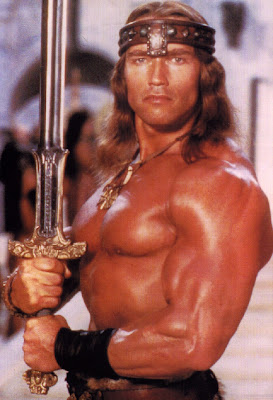
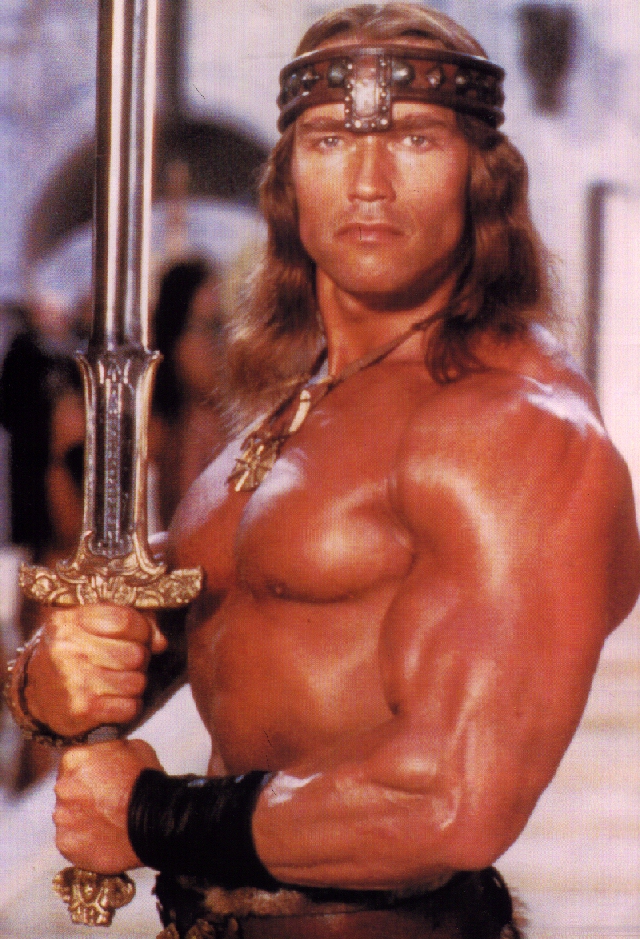
I don't mind sexing up pictures as long as the playing field is level. If every male character is a Conan type wearing a loincloth and a sword then I have no issue with saucily dressed female characters either (but not in heels, please). Clothes on, clothes off, either way is fine as long as we have it the same for everyone. I am never going to look like Conan just like the great majority of women aren't going to look like Miranda but that is almost universally the case in stories; the people are stronger, smarter, richer and better looking.

Miranda pic from http://masseffect.wikia.com/wiki/Miranda_Lawson
Arnold pic from http://tonightatthemovies.com/indexhold/?p=14365
For example, in WOW the characters are idealized. This is true for both men and women though as the women have a perfect hourglass figure and the men have broad shoulders and are outrageously muscled. So muscled, in fact, that their arms and hands are freakishly large and inhuman. Nobody sags, pot bellies are nowhere to be seen and even the elderly have the breasts of lingerie models or the biceps of olympic weightlifters. In fact I find that the female characters seem a lot more appropriate for caster classes than male ones because somehow it feels wrong that a male warlock who wears cloth and carries only a dagger has arms big enough to crush skulls with; in the same way the females look strange as melee classes because they have normal arms wielding 2 meter long swords. The real difference comes in the clothing. Put the same gear on a male and female character and you can often see a big difference in how much skin is showing and obviously the female is always the one wearing less.
I don't have a personal objection to this to some extent; I happen to like females unclothed so when I see this sort of stuff I wish it went both ways rather than wishing for the women to be covered up. I don't mind eye candy for those who like undressed men so long as I get my eye candy too! The thing that does get me frustrated though is the utterly ridiculous and immersion breaking sexifying of women in games, particularly high heels. I understand the basic principle of high heels in real life; they change the shape of women's legs in a way that appeals to most men. (I have no idea if it is as appealing to most women who are attracted to women.) High heels are awful things in real life where the people wearing them walk around on sidewalks and sit at desks; they are not appropriate at all for adventuring! Both the female demon hunter in D3 and many of the female heroes in Mass Effect 2 wear high heels all the time and it looks utterly silly. These are characters that plan to run from cover to cover, leap over objects and dive away from explosions and they choose to wear 15 cm stilettos? Preposterous. Even more so it is *easy* to change the shape of the legs of these women to be more appealing without adding the idiotic footwear! Women in real life can't do that but there is no excuse whatever in video games for adding in action heroes wearing heels except to objectify them.

Miranda pic from http://masseffect.wikia.com/wiki/Miranda_Lawson
Arnold pic from http://tonightatthemovies.com/indexhold/?p=14365
Tuesday, April 24, 2012
Crowd control done right
I complained some about crowd control in Mass Effect before but today I come before you with nothing but praise. ME2 really found a fantastic way to deal with crowd control effects that I have not seen before and which seems like a great way to deal with the issue: Allow crowd control effects only on enemies that have all of their defenses (shield, armor, barriers) destroyed. The genius of the idea is that it not only works well for bosses but also allows really nice difficulty level scaling too. Any mooks that the designer wants to be very easy to throw / fear / mind control can be spawned with no defenses allowing the player to horribly abuse them. Bosses can be started with multiple layers of protection on them though which means that they have to be fought for awhile and have most of their effective health stripped away before they are vulnerable to crowd control effects. This means that in any given fight crowd control can be used but that simply bringing a barrage of crowd control effects and nothing else will be disastrous whenever you encounter something challenging. Perfect!
I particularly like this solution because it means that you can dial up the difficulty significantly without completely changing the fight. Just adding some extra armor or shields onto random enemies not only increases how hard it is to kill them but also means that using CC effects becomes more and more difficult. On lower difficulties it is fine to lets players horribly maul the enemies by stacking CC but there needs to be some way to mitigate that that isn't just 'MOAR DUDES!' when the difficulty goes up. There are also the considerations of lore and immersion to keep in mind; having some enemies be inexplicably immune to things can be frustrating and feel very kludgy. Having a consistent mechanic across the whole game where some enemies have greater protection and cannot be CCed until that protection is gone feels reasonable and the fact that bosses simply have more protections that other people is a nice solution. Any time you mouse over an enemy you can tell what will work on them and what won't rather than nasty "Sorry, immune to that!" gotcha moments.
In WOW CC was often a problem (Magister's Terrace anyone?) where groups would sit around waiting for a mage because the mage brought the best crowd control in the game. If a group of four enemies is winnable then a group of three enemies must be extremely easy in comparison so crowd control became very prominent and left those classes or parties without it in a bad situation. This led Blizzard to give basically every dps class a CC power because otherwise balanced groups and encounters were really hard to design; that is, unless you just made everything immune to CC which has its own problems. The ME solution is so much better because it lets the designers build challenges that cannot be trivialized by stacking CC without making CC irrelevant. Given the overall design of WOW fights I can't see how they could implement something similar unfortunately; the design that every monster is pounding on the tank means that CC has to be useful right off the bat or it will be entirely ignored.
Unfortunately I don't have a lot of ideas for how to incorporate this into tabletop games (too much bookkeeping) nor even WOW style fighting games. The major issue with WOW in this sense is that it has a PvP element. Setting up the game such that as soon as you get seriously damaged you suddenly lose all control over your character seems like it would be really frustrating and would be quite strange with effective in combat healing. Not that this solution wouldn't work for MMOs in general but I don't have a particularly good sense of how they run mechanically. The only one I know inside out is WOW and although CC in WOW is a mess I don't think this (or any other solution I have ever seen) will fix it barring other major system overhauls.
Thursday, April 19, 2012
Real world debates in games
I am currently working my way through Mass Effect 2. In the original game the story of the krogan genophage was told and the story continues in ME2. The basic idea:
The krogan are extremely dangerous alien fighters. They also reproduce like crazy.
If the krogan are left alone their population explodes and they end up conquering and destroying everyone.
Other species decided to infect the krogan with a tailored genophage that drastically reduced their fertility; only one in a thousand krogan newborns is born alive. This was done to keep the krogan population steady and keep them from becoming an unstoppable threat without destroying them.
The genophage has caused all kinds of bad changes in krogan society and outlook.
Question: Is creating the genophage ethical?
From a strictly utilitarian viewpoint I can certainly see creating the genophage being ethical. When faced with imminent attack by a superior military force bent on your destruction it is acceptable to defend yourself with whatever force is necessary to stop the attack. To my mind it is acceptable to go further than that though; if all you do is stop the immediate attack you may well face another attack whenever it suits the enemy. Just like Ender did in Ender's Game I think it is morally acceptable to inflict additional punishment on an aggressor sufficient to deter future attack but that the additional punishment should stop short of revenge. Attacking for vengeance is not morally acceptable but attacking to prevent future conflicts is. In this case the genophage does the minimum possible damage that could be inflicted to prevent a devastating future conflict without destroying the krogan entirely; the best possible solution from a dismal set of choices.
The debate in ME2 ends up being framed very similarly to the abortion debate in the real world. Is killing a sentient being different from causing a baby to be stillborn? I think it is, which should not be surprising as I am very much pro choice. In ME2 the choice is framed in terms of Paragon and Renegade points; it seems as though the attitude that the genophage is wrong is Paragon and thinking that the genophage is a necessary evil is Renegade. It is a little strange because I am going through the game wanting to choose the Paragon options mostly but I sure wanted to be a Renegade whenever these questions came up. I can't really wrap my mind around the idea that the genophage is wrong; is a galaxy wide war and the utter destruction of at least one race a preferable result? If the genophage is cured then either the krogan must be destroyed or all other races must be destroyed instead; no other option presents itself.
I wonder if the parallels to the abortion debate were noticed when the game was being built. I certainly couldn't avoid seeing it as I went through Mordin Solus' quest mission in particula; I also wonder if the other players of the ME games notice the same. It seems like the genophage is being presented as somewhat morally ambiguous since I have options to either stop it or sustain it. I would be curious to know what the game developer's beliefs were on the abortion issue; it might give me some insight into how they develop games.
Tuesday, April 17, 2012
Mass Effect and me being wrong
Last week I posted about balance issues in Mass Effect 1. In particular the crowd control (CC) biotic effects seemed to be exceedingly powerful in some situations (beating up regular.dudes) and weak against bosses. I think that balancing CC effects is really tough but my impression of how well ME managed it is much brighter now. Against the one boss that I found extremely difficult, the krogan battlemaster, my CC effects seemed exceedingly weak and that really coloured my perceptions. Having completed the entire game on Hardcore difficulty though I have changed my mind: There are definitely some spots in the game where CC effects are weak but overall they are very useful. Even the majority of boss fights have times where the boss is vulnerable to such effects or at least have dorks that can be tossed around.
One thing I found very strange in that game is that finding gear is completely tied to level. If you visit Zone A when you are level 10 you will find rank 2-3 equipment and if you visit it when you are level 50 you will find rank 8-10 equipment. This ensures steady loot progression throughout the game regardless of what order you do the fights in. It also has some really weird balance repercussions though because if you decide to simply do every mission, visit every zone and kill every enemy in the game you end up extremely high level; this leads not only to having more hitpoints and skills but also to having completely absurd gear. The other very strange thing about this mechanic is that money acquisition follows a scaling formula based on level too; it was utterly bizarre to collect one piece for an early mission and get 100 credits and then get 6,000 credits for collecting another piece just because I levelled up a bunch in the interim.
I don't know how I feel about the this gear mechanic. In some ways it is great that you can't just slip ahead to high level zones to get overpowered gear and that you have consistent gear progression throughout the game but on the other hand it does make the game feel more grindy as you are massively rewarded for doing *everything* instead of picking and choosing. There is no possibility of catching up if you skip things along the way. This became really obvious as I got endgame gear because initially in Hardcore difficulty I had to play well and try hard but at the end I just mowed down every enemy I saw with utter disdain; my equipment was so powerful that there was practically no challenge at all. It certainly means that the challenge level of Insane difficulty would be fairly warped; I am sure the beginning would be an utter pain in the ass but once I get out in the world I can tour around doing mining and surveying to level up to trivialize the later encounters. I don't want the challenge of the highest difficulty level to be the tedium of driving my truck up and down annoying mountains to find more ore to survey.
What's that you say? I could stop being completionist and just go do the major plot points at low level? Unfortunately for me that just isn't fun. When I set a particular difficulty level I want to then do everything within my power to beat it. Having to constantly say "well, I won't do *that* because it makes things too easy" is frustrating rather than exhilarating. If all the enemies in the game scaled appropriately to your level it would work out all right but they don't. Apparently the bosses and minibosses scale somewhat but they sure don't seem to scale enough. I like the difficulty scaling in ME1 but I wish they did something to mitigate how much more power you get from doing all the random side missions somehow.
Friday, April 13, 2012
Skills and the pressure to learn them
Tobold talked yesterday a bit about the fun involved in learning and mastering new skills. His basic thesis is that people have a lot of fun learning skills but they get bored and stop having fun once the learning stops. One of the things he calls for is people making new and interesting games that are extremely different from what has come before to avoid the problem of early mastery. I certainly think that there is a tremendous amount of transferable skill from some games to others. Many games of virtually any genre have substantial skill crossover from MMOs to shooters to turret defence. I can say for sure that the reason I was able to start playing Mass Effect on Veteran difficulty is because I spent so much time playing WOW and Doom 2. Strafing in and out to snipe enemies and hitting lots of skill buttons without looking away from the screen are skills that easily go across games and reduce the learning curve a lot.
I am not so easily convinced that games need to have truly revolutionary mechanics to be tremendous fun though. I finished Portal 1 and then played Portal 2 and I had a hell of a good time in the second game. There were a few new mechanics but I didn't feel that they really added a huge amount to the game - the structure and ambience was noticeably different and I really enjoyed the newer, bigger areas to play around in. Mostly though I really just wanted more of the same and exploring through the game was awesome. I think entirely new mechanics can add a little bit more to a game's longevity but eventually the player maxes out the skill needed to beat the game's challenges and then exploring is the only thing keeping them going.
Ratcheting up the difficulty of the game can actually be a really good way to change the mechanics. For example, if you are just playing through the levelling game of WOW you can easily get to the level cap with only 3 abilities on your bar. This isn't optimal in any sense but it is easily doable. When you get to raiding you will suddenly realize that you simply have to use more abilities and learn new techniques. I was good for a long time at jump spinning to get extra attacks in on mobs while running but I really mastered it while fighting Sindragosa hardmode. That fight was absolutely full of running away from the boss and learning to use all of my abilities in the correct order while running was a challenge - they all had different GCDs and ranges so a lot of expertise was needed to maximize my damage. (Whether or not this maximization really led to significantly improved kill rates is questionable!) Despite having played WOW for 4 years at that point I was still learning because the fight was hard enough to force me to learn.
I feel the same way about Mass Effect. While playing on Veteran I pretty much ignored all of my abilities because I was able to get by with just strafing, ducking behind cover and shooting. When I ticked the difficulty up to Hardcore I suddenly could not get by; I had to precast shields, use my crowd control, manage cooldowns and retreat more often. I also had to read all of my abilities and make more careful choices when levelling up. I learned more and had more fun because the game was hard enough that I had to. Just like doing WOW hardmodes required me to learn entirely new things like doing 95% of optimal DPS while still watching boss mods, cast bars, fire on the ground and other environmental signals there is an entirely new set of skills just waiting to be mastered when the challenge level goes up.
I definitely think that revolutionary games like Portal have a much easier time of creating fun because they don't have to ride that edge of hard but doable so much; the novelty creates the fun. When a game is created that uses established mechanics and which people can easily apply old skills to I think it is much harder to be fun because you need more content or more tightly tuned challenges. Bringing innovation to the table can really lower the bar for the rest of a game but it isn't required; give people tough but fair challenges and a world to discover and it can be fun just the same.
Tuesday, April 10, 2012
More Mass Effect
Crowd control effects are really problematic to balance. This is something I am really coming to notice in Mass Effect now that I have started playing through on Hardcore difficulty. Initially I started on Veteran with a pure Soldier build but I decided to do something different for Hardcore and went with a mixed Biotic / Combat character. What this means to those who haven't played the game: Biotic abilities are mostly crowd control powers that have cooldowns. You can toss people around, lift them up, disrupt their abilities, etc. Combat abilities mostly give you passive damage reduction, more hitpoints, more damage and more healing. This seems to work out fine in most circumstances because when random enemies attack you it is very useful to use Biotic abilities to wreck them but having better numbers helps a lot too. When there are groups of enemies attacking both builds seem solid and reasonable because they each have advantages and disadvantages. Problems start to arise though when you fight just 1 enemy.
If the 1 enemy you fight is a dork then Biotics are ridiculous. First the dork takes a bunch of damage and gets a debuff that makes him take more damage. Then he gets knocked down. Then he gets to float around in the air for awhile. While he is taking these vacations he is getting shot by your entire team and dies exceedingly quickly. The other end of the spectrum is found when you fight a boss because they are immune to Biotic attacks. Try to knock them down? Nope. Try to toss them around? Nope. You basically end up relying on a lot of shooting and ducking and getting hit instead and the Combat abilities become paramount. You might think that this is all fine because Biotics are good sometimes and Combat is good other times but obviously that would require boss fights and fights against 1 dork to be equally important. Because bosses are hard and 1 dork is trivial then the game becomes a lot more slanted towards being a Soldier type and just having big numbers on your side.
I certainly found Hardcore to be a real challenge unlike Veteran. I don't know how much to chalk up to difficulty setting and how much to my new build being inferior in very specific situations though. In particular the Krogan Battlemaster boss (while rescuing Liara) pretty much acted like a WOW raid boss. He stood behind pillars and shot at me, which was survivable but unpleasant, and occasionally would try to rush me. If he rushed me it was very bad because he shot for 20% of my health bar and hit with his fists for 80% of my health bar. Also when he was in melee range my character defaulted to melee attacks ... which he is immune to. I had situations where I engaged him at range, brought him down to 20% of his health with my entire team at full with all cooldowns up and he charged in and murdered all three of us quite trivially. I ended up having to develop (over the course of 15 wipes) a strategy where I kited him behind pillars and refused to engage except when he was mostly under cover sniping me. Killing him from that position was annoying and slow but it was doable while letting him have a direct line to me (even at maximum range) was death.
For most of Mass Effect I fight in ways that seem really sensible from a roleplaying perspective like ducking behind cover, retreating to draw enemies into traps, sniping when possible, etc. but for this fight it was pure AI abuse. I figured out the AIs attack routine and made sure it never got to a spot where it would decide to charge and ruin me. Obviously that is what you do in video games most of the time; you figure out the hole in the boss' attacks and abuse it over and over until the boss dies. It is a little unfortunate in this case though because otherwise the game's fighting strategies and roleplaying really played nicely together and in this case I had to game the system pretty severely. The Krogan Battlemaster fight certainly had my heart pounding but it definitely didn't have me playing in character.
Thursday, April 5, 2012
Mass Effect
I am playing through Mass Effect this week. It is a really fun game and I find that there is a pretty good balance between combat and story - it is also nice that you can skip past either of the two elements fairly quickly if you want to. One thing I noticed is that it is shockingly like a Final Fantasy or similar type RPG once you get past the spaceship and lasers overlay. There are lots of enemies to fight and they always give you XP and sometimes give you stuff! A hardcore twink like myself cannot resist the lure of more stuff so I do every side quest, find every storage locker (treasure chest), hunt down every last geth (monster) and refuse to spend money on anything because I want to save it all up for the endgame. Buying gear and then selling it back to the vendor at a loss is unacceptable - only buy things that will never, ever obsolete! In the same vein the classes read much like fantasy RPG classes. I am a fighter and my two friends in my party are a fighter (Ashley) and thief/cleric/mage (Kaidan). Thankfully 'multiclassing' in ME is actually quite good and I basically have two tanks who do all the killing and one guy following us around CCing the enemies, opening locks and healing (having lots of First Aid). I guess some general designs are just timeless and transcend genres.
One thing that really irritates me though is that much like Final Fantasy 1 the combat mechanics are entirely unexplained. How can I find out what my accuracy ratings on weapons do? What does increasing my accuracy regenerated per second by 1% even mean? Just like in FF1 you can experiment randomly with weapons to see what happens but the tooltips seem to give a lot of information that is quite useless for making decisions. I am used to WOW where I can get really detailed combat logs to allow me to make good decisions and in ME I can't see how you would figure this stuff out without just playing through the game a bazillion times. I am not advocating providing tons of explicit combat log data to everybody. Most people would find it irritating and useless because they just want to put a lot of points into shotguns and then shoot people with shotguns - as long as that works the numbers aren't helpful. I sure wish that the game had a good combat mechanics section in it though that told me exactly what my stats are and what they do; right now I look at weapons that have 150/1 damage/accuracy and compare them to 140/5 and there is nothing whatsoever that tells me whether or not the new item is an upgrade and it is exceedingly unlikely I could figure that out just by shooting the enemies.
I do like the Paragon/Renegade system. You can earn points towards either as both are essentially reputations - you can be known for being a badass or a hero or both. My first playthrough I am playing mostly to get Paragon points and doing the good guy thing but I plan on running through the game as a pure Renegade next time so I can select "Bite me" from the menu a lot of times and see what happens. I took max points in both Charm and Intimidate to give me lots of chat options on my first playthrough and that looks to have been a mistake since I only had a chance to use them 3 times so far in my 15 hours of play and they haven't been particularly useful even then. Next time through my biotic assassin isn't going to mess around with 'talky' skills - I am going to have two responses to situations - kill them or tell them to F off.
Subscribe to:
Posts (Atom)